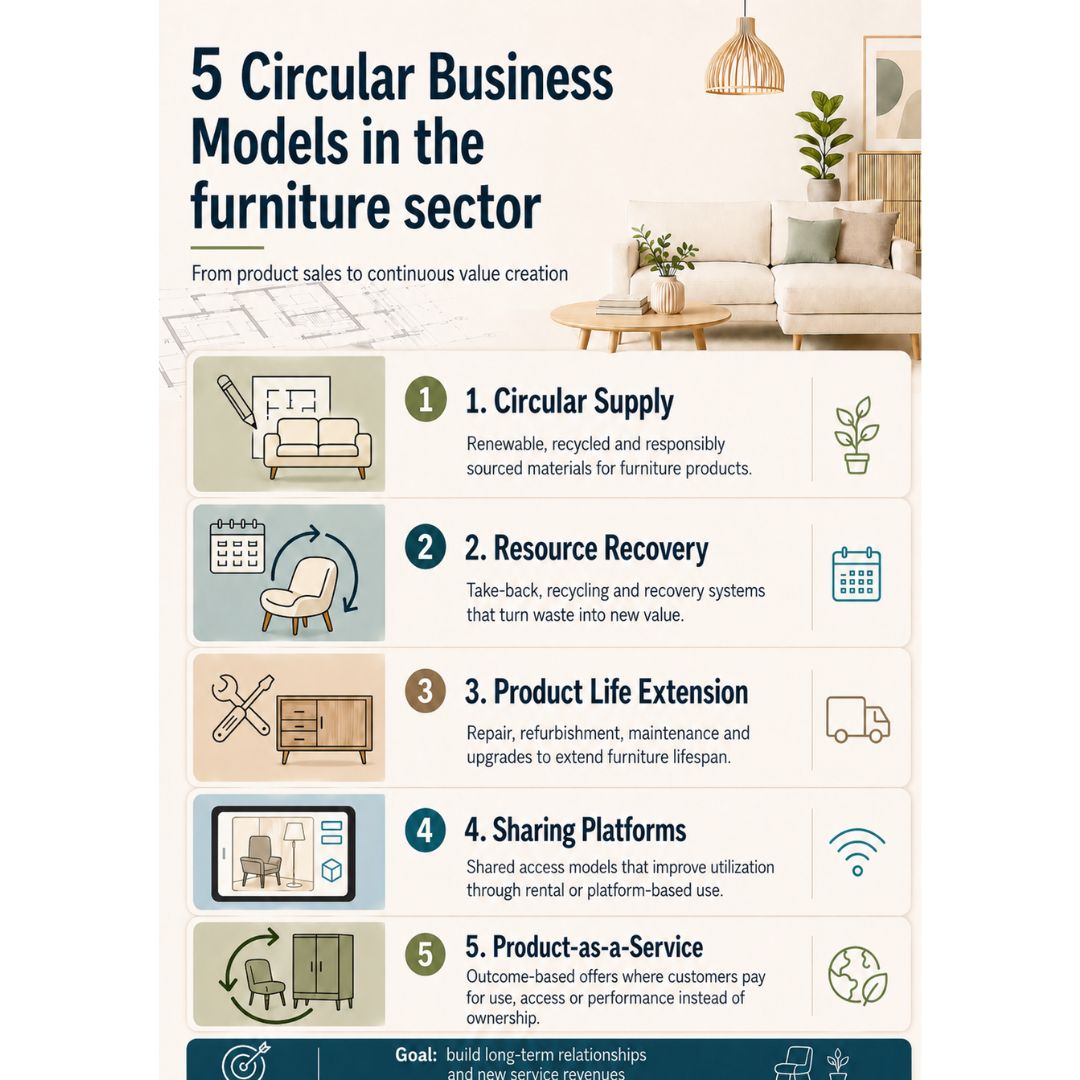
A new guide is on its way and will be ready in autumn 2026, helping furniture companies explore circular business models in a clear, practical and business-oriented way. The document looks at how the European furniture sector can move beyond the traditional “take-make-dispose” model and unlock new forms of value.
It starts with a snapshot of the industry today: strong design, high-quality production, SMEs at the heart of the sector, but also growing pressure from resources, waste, regulation and global competition. From there, the guide introduces Circular Economy as more than an environmental concept: it is presented as a strategic toolbox for resilience, innovation and competitiveness. Readers will find an overview of key policy drivers, including new circularity requirements, sustainable product design and the role of traceability. The report also explains why value retention is central: keeping products, components and materials useful for as long as possible is where circularity becomes a real business opportunity.
At the core of the document is a classification of five Circular Business Models for the furniture sector. These are: Circular Supply, Resource Recovery, Product Life Extension, Sharing Platforms and Product-as-a-Service. Each model is presented with its main logic, expected impacts, implementation complexity, challenges, enablers and transition steps. The guide also includes more than 190 case studies and examples to show how these models can work in practice. Rather than proposing one perfect solution, the document shows that companies can combine different strategies depending on their products, markets and capabilities. The message is clear: circularity is complex, but it can start with focused, scalable actions. It may involve new services, new partnerships, new customer relationships and new revenue streams. Most importantly, it offers the furniture industry a way to turn today’s environmental and market pressures into long-term competitive advantage. Full details will be available in the guide in autumn 2026 — but this first look already shows why Circular Business Models are becoming a key topic for the future of furniture.